On the ground
Valley of the Kings: which tombs are open
How the Valley of the Kings works on a day trip: which tombs can open, what a ticket covers, the extra-ticket tombs, the rules inside and what the walls show.
See Luxor day trip tickets on GetYourGuide ↗Quick answer
The Valley of the Kings has more than sixty tombs, but only around eighteen can be opened, rarely all at once, so what you can enter changes. A standard ticket has covered three tombs from the list open that day, and Tutankhamun's tomb carries a separate charge. On the private day trip from Cairo, entry fees are included; ask the operator which extras, if any, are covered.
Tomb tickets at a glance
| Ticket | Covers | On this tour |
|---|---|---|
| General entry | Three open tombs | Entry fees included |
| Tutankhamun's tomb | One tomb, own charge | Not stated; ask operator |
| Seti I's tomb | One tomb, own charge | Not stated; ask operator |
| Tomb of Ay, West Valley | One tomb, own ticket | Not on the itinerary |
Why only some tombs are open
The valley holds more than sixty tombs and about twenty unfinished ones. Around 18 can be opened, but they are rarely open at the same time, and officials close some for restoration. Occasional flash floods also dump debris into open tombs. So the list you can enter changes with the season and the year, and no guidebook can promise a particular tomb. Almost all of them were opened and robbed in antiquity, so what remains to see is the decoration, not treasure.
What a standard ticket covers
A standard ticket has covered three tombs from the list open that day, and the attendant marks it at each entrance. Each open tomb has a sign with a floor plan, and the visitor centre has a large map of the valley. Plan on roughly one to two hours for three tombs. Visitors also buy a tram ticket at the visitor centre for the ride up to the valley, which on this tour is a question for the operator rather than something the booking lists. On the day trip the entry fees are included, so you are choosing among the open tombs rather than paying at the counter. If there is a tomb you most want to see, tell your guide before you reach the valley.
Tutankhamun's tomb
Howard Carter's team found the tomb, KV62, in 1922. It is small for a royal tomb and less decorated than others of its time. Tutankhamun's mummy lies in a climate-controlled glass case in the antechamber, and the stone sarcophagus is still there. Most of the tomb's contents went to Cairo and are now in the Grand Egyptian Museum in Giza. So the tomb is where you see the king himself, and the museum is where you see the objects. Demand is so high that the tomb carries a separate charge. A replica of the burial chamber, opened to the public in 2014, stands nearby to take some of the pressure off the original.
Seti I's tomb
Giovanni Belzoni uncovered KV17 in 1817. It is one of the largest and deepest tombs in the valley, and its walls, ceilings and columns are covered with reliefs and paintings, well preserved in nearly all of its chambers and side rooms. The burial chamber ceiling shows gold stars on deep blue. Travel guides list it as a separate ticket, and like any tomb it is not open on every day. Choose it for the decoration rather than a famous name, and confirm on the day that it is open. If you pick only one extra, the choice is between the best-known occupant and the most elaborate walls.
What the walls show
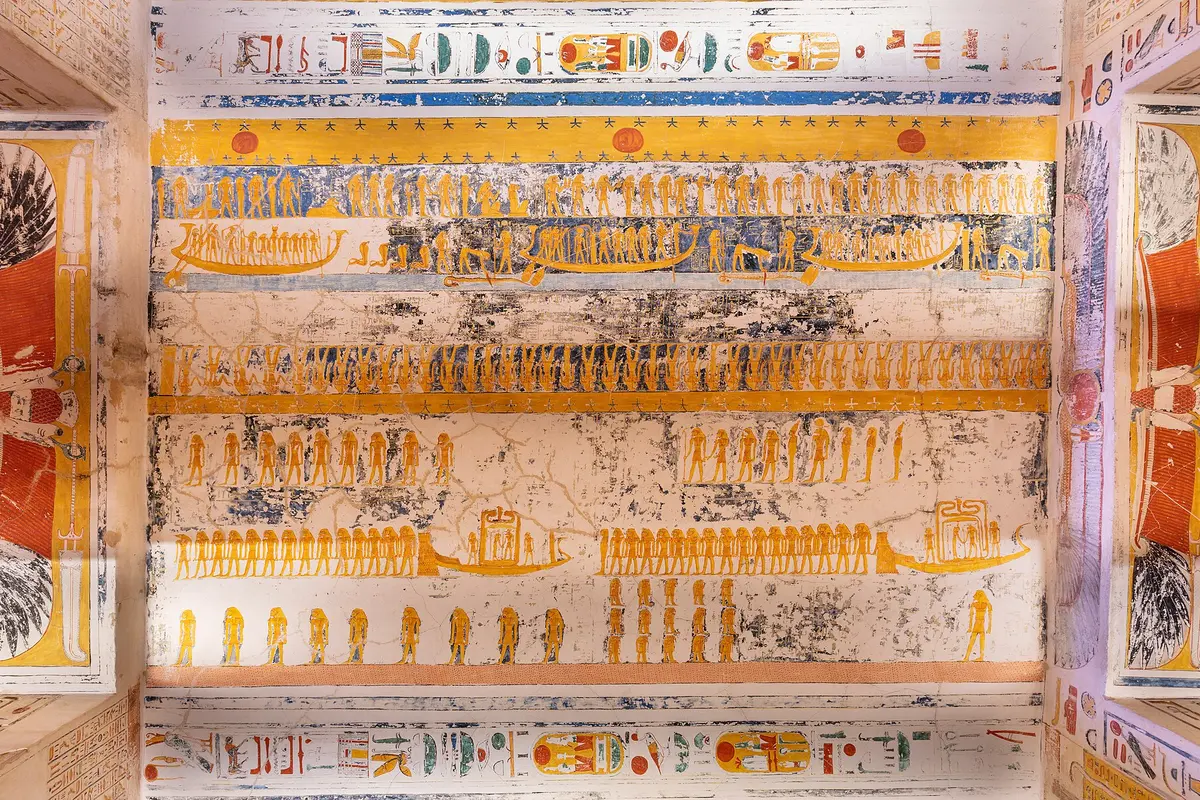
The decoration is a guide to the afterlife the kings expected. The Amduat follows the sun god through the twelve hours of the night. The Book of Gates shows him passing through twelve gates. From the reign of Seti I the Book of the Heavens appears on burial chamber ceilings, alongside the Litany of Re, a hymn to the sun god. KV9, the tomb of Ramesses V and VI, is known for its sunk-relief carvings and for over a thousand Greek, Latin and Coptic graffiti left by ancient visitors.
Other tombs you will hear about
Guides and guidebooks mention several more. KV11, the tomb of Ramesses III, is one of the largest and one of the most visited. KV14, built for Twosret and reused by Setnakhte, has two burial chambers. KV35, the tomb of Amenhotep II, was used to hold a cache of royal mummies moved there in antiquity. KV7, the tomb of Ramesses II, is under excavation and conservation by a Franco-Egyptian team. Whether any of them is open on your day is the question to ask, because the list changes.
Rules inside the tombs
Visitors are expected to go through quietly and in single file. Guides are no longer allowed to lecture inside the tombs, so expect your guide to explain what you will see at the entrance and then walk through on your own. Camera rules have changed over the years, and published accounts disagree on whether phones and cameras need a permit, so ask at the ticket office or the tomb entrance before you raise one. Attendants sometimes offer to take your photo and expect a small tip.
Heat, stairs and crowds
The tombs tend to be hot, and warmer the deeper you go. Each tomb means walking down staircases and back up again, and the walk from the tram to the tombs is uphill. Luxor's summer highs average above 40 degrees Celsius and it gets under 1 mm of rain a year, so sun protection and water matter outdoors. On most days thousands of people visit the main valley, so even three tombs can feel crowded at the busiest hours.
Hatshepsut's temple and the Colossi
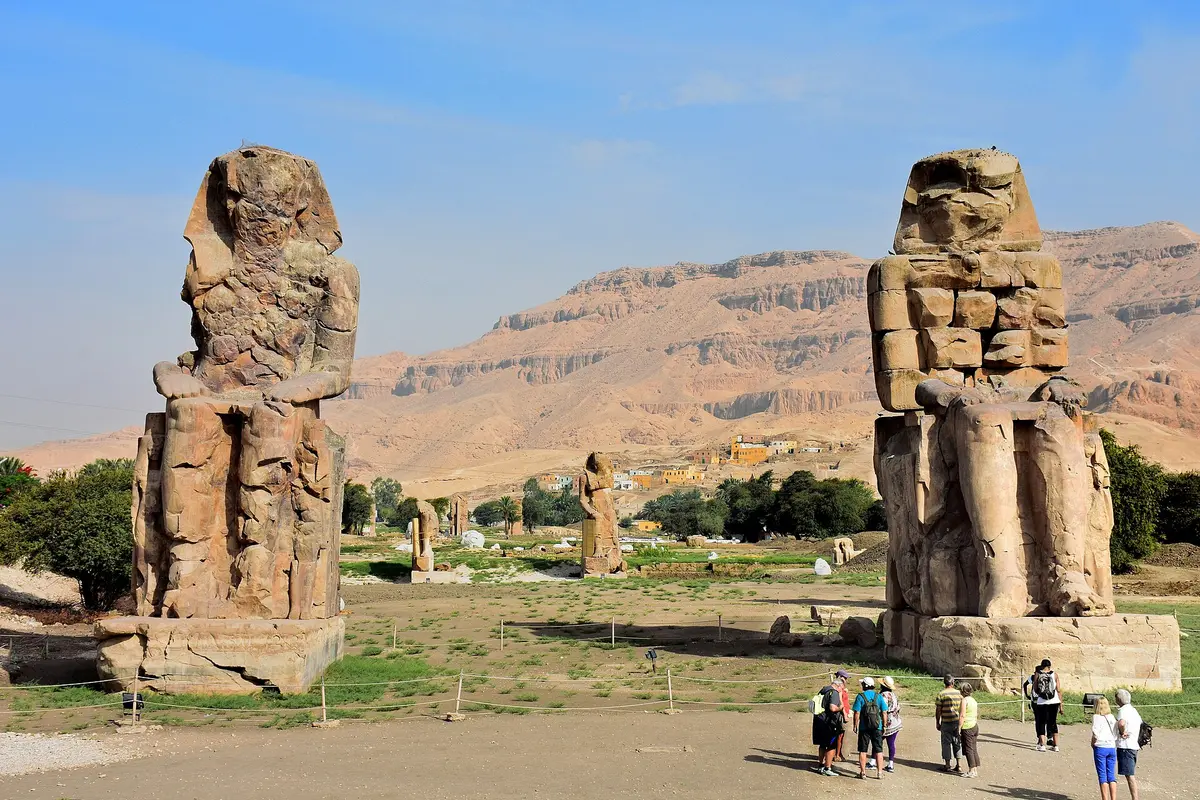
The same West Bank morning includes two more stops. Hatshepsut's temple at Deir el-Bahari is built against the cliffs, across the Nile from Karnak, on three terraces rising from the desert floor. The Colossi of Memnon are two seated statues of Amenhotep III, about 18 m high including their platforms, standing at the front of his ruined mortuary temple. After an earthquake damaged the northern statue, it was said to sing around dawn, and the sound stopped after the Romans repaired it.
Read next: Karnak and Luxor Temple in one afternoon
If you go on your own
A private tour is not the only way. If the valley is the point of your trip, base yourself in Luxor and set your own pace. You can spend a whole morning here, add the Valley of the Queens, and come back on another day if the tomb you want is closed on the first. You would arrange the transport on the West Bank yourself, whereas the tour includes it. Tickets are sold at the visitor centre, so a tomb you decide to add after boarding the tram means a ride back. The bridge opened in 1998 links the two banks by land.
Read next: Cairo to Luxor: day trip or overnight?
Who this isn't for
If you are set on one particular tomb, a day trip cannot promise it, because the open list changes. If you want to linger for hours in Seti I's tomb or add the Valley of the Queens, a stay in Luxor suits you better. If hot, enclosed, stair-heavy spaces are hard for you, think about how many tombs you want. And if you hope for a guide's commentary inside the tombs, know that it is not allowed.
Frequently asked questions
Which tombs are open in the Valley of the Kings?
It changes. About 18 tombs can be opened, rarely all at once, and some close for restoration. A standard ticket has covered three from the list open on your day. Tutankhamun's tomb and Seti I's tomb are sold as separate extras.
How many tombs are in the Valley of the Kings?
More than sixty, plus about twenty unfinished ones, according to Egypt's monuments authority. The numbering runs from KV1 to KV64. Only a small number can be visited at any one time.
Is Tutankhamun's tomb included in the day trip?
The booking lists entry fees as included but does not say that Tutankhamun's tomb is covered. It carries its own charge, so ask the operator after booking if you want it.
Can I take photos in the tombs?
Rules have changed, and published accounts disagree on permits for phones and cameras. Ask at the ticket office or the tomb entrance before you start, and do not assume the rule is the same in every tomb.
Where is Tutankhamun's treasure?
Most of it is in the Grand Egyptian Museum in Giza. In the valley you see the burial chamber, the stone sarcophagus and the king's mummy in a glass case.
How long does the Valley of the Kings take?
Three tombs take roughly one to two hours at a normal pace, and each extra tomb adds time. On the day trip your schedule also has to leave room for the other West Bank stops.
Sources
- Valley of the Kings (Ministry of Tourism and Antiquities)
- Valley of the Kings: the complete guide (Earth Trekkers)
- Valley of the Kings (Wikipedia)
- KV17, tomb of Seti I (Wikipedia)
- KV62, tomb of Tutankhamun (Wikipedia)
- Colossi of Memnon (Wikipedia)
- Mortuary Temple of Hatshepsut (Wikipedia)
- Luxor (Wikipedia)